A child eye examination involves more than asking a child to read letters from a chart. You will know what to bring, which tests the clinician may perform, when your child can stay with you, and what to ask before leaving with a prescription or follow-up plan.
Key takeaways
- Bring previous reports, current medicine details and your child’s school-year information.
- Children name pictures or match symbols when they cannot read an eye chart.
- Dilation drops can blur near vision and increase light sensitivity for several hours.
- Ask when results, glasses, follow-up or treatment decisions will be reviewed.
Check-in, history and helping your child settle
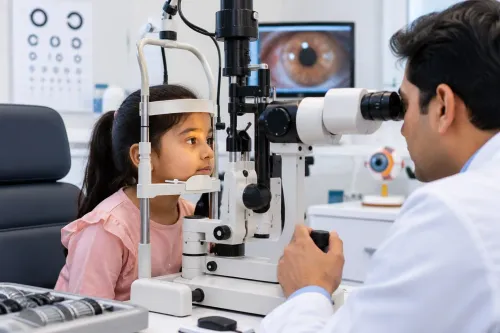
A pediatric eye examination in Lower Parel begins with check-in, not the letter chart. The clinician confirms your child’s age, school year, previous reports, current medicines and the reason for the visit.
A parent usually stays in the room, especially with infants and anxious children, while the clinician explains each step and turns it into a game when possible.
Give clear details about:
- Birth history, including premature birth, time in neonatal care, and developmental or neurological conditions.
- Family history of glasses, squint, lazy eye, childhood cataract, glaucoma, or inherited retinal disease.
- Symptoms such as headaches, eye rubbing, closing one eye, sitting close to screens, double vision, or difficulty seeing the board.
- School performance, reading fatigue, avoidance of near work, clumsiness, or complaints that one eye sees poorly.
- Previous glasses, patching, eye drops, surgery, injuries, or other eye treatment.
The clinician then watches how your child fixes on and follows a light or toy. Older children may identify letters; preschoolers can match pictures, symbols, or directional shapes. Each eye is tested separately because a stronger eye can hide reduced vision in the other.
If your child refuses, cries, or loses concentration, the examiner can pause, use a familiar object, let you demonstrate first, and repeat the measurement. Tell the clinician what your child normally does at home rather than prompting answers.
How visual acuity is measured at different ages
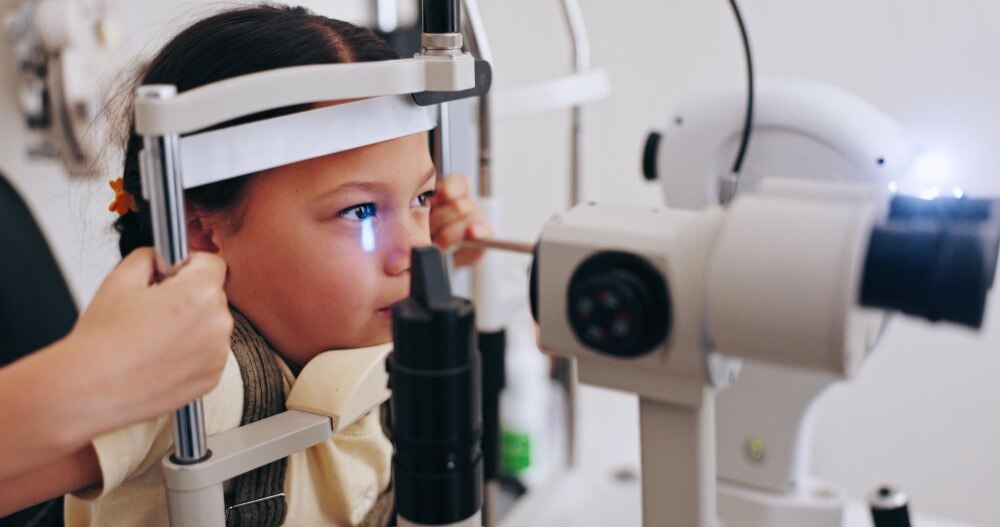
A child does not need to read letters for the clinician to measure vision. During a child vision test in Lower Parel, each eye is usually tested separately with the other eye covered, because a child can rely on the stronger eye and hide reduced vision in the weaker one.
- Infants: The clinician watches whether the baby fixes on a face or light, follows a toy, and keeps looking when one eye is covered. A clear difference between the two eyes can signal reduced vision even without a chart.
- Toddlers and preschoolers: The child matches a symbol or picture on a card, or identifies the direction of shapes such as the “E” in a tumbling-E chart. The examiner may show the answer card first so the task is about matching, not naming.
- Older children: The child reads an age-appropriate distance chart, usually one eye at a time, then repeats the test with both eyes open.
If the child becomes anxious or stops cooperating, the clinician may use shorter trials, familiar pictures, play, or observation of fixation and following rather than force a response. A quick pass does not rule out every problem.
If you are asking what happens during child eye for examination in Lower Parel, expect the method to change with the child’s age, attention, speech, and comfort.
Alignment, eye movements and the glasses assessment
A children eye doctor in Lower Parel checks whether the eyes point at the same target and move together, not just how clearly each eye sees. During a cover–uncover test, the child looks at a toy or light while one eye is covered; a shift in the uncovered eye can reveal a manifest squint.
Alternate-cover testing switches the cover between eyes and breaks their ability to work together, exposing a hidden or intermittent deviation.
| Test | What the child does | What it shows |
|---|---|---|
| Cover–uncover | Fixes on a target while one eye is covered | A manifest squint, or an eye that moves when uncovered |
| Alternate cover | Looks at the target while the cover moves between eyes | The size and direction of an eye misalignment |
| Eye-movement assessment | Follows a light or toy in different directions | Restricted movement, an unusual movement pattern, or a concern involving the orbit or nervous system |
| Corneal light-reflex check | Looks toward a small light | Whether reflected light falls symmetrically on both eyes |
The clinician then assesses spectacles with refraction. Younger children may respond through fixation and following, while older children read or match chart symbols one eye at a time. Cycloplegic refraction uses drops to relax focusing and measure the underlying prescription; without it, a child’s focusing effort can make the glasses strength look inaccurate.
A prescription is not automatic: the result may support observation, spectacles, or further assessment.
When dilation is needed and what your child experiences
Dilation helps the ophthalmologist see the retina, optic nerve and other internal structures at the back of the eye. Cycloplegic drops also relax the focusing muscle, allowing a more accurate glasses measurement instead of a prescription altered by a child’s active focusing.
This is especially useful with reduced vision, suspected squint, high refractive error, an unusual red reflex or unexplained symptoms.
The drops may sting briefly. The clinician will wait for them to work, so a pediatric eye examination in Lower Parel can take longer than a basic vision screening. While waiting:
- Bring a snack, water and a familiar toy or screen for distraction.
- Expect blurred near vision, so reading or looking closely at a phone may be difficult.
- Carry sunglasses or a hat; bright light can feel uncomfortable after dilation.
- Arrange a calm journey home and avoid planning schoolwork immediately afterwards.
Blurred near vision and light sensitivity often last for several hours, with the exact duration depending on the drops and your child’s response. Your child can usually resume normal activities once comfortable, but ask the clinician before returning to sport or other activities requiring sharp vision.
Pediatric ophthalmology in Mumbai clinics may use different drop combinations for different ages, so follow the specific aftercare instructions rather than relying on another child’s experience. Contact the clinic promptly if severe eye pain, marked redness, vomiting or a sudden, persistent change in vision develops.
Results, treatment choices and what to do after the visit
The result may be more than a glasses prescription. After a child vision test in Lower Parel, the clinician should explain what each eye sees, whether the eyes align, and whether vision in one eye is falling behind.
Possible recommendations include:
- Observation with a defined review date when vision and alignment are developing normally.
- Spectacles for short-sightedness, long-sightedness, astigmatism, or unequal prescriptions between the eyes.
- Patching the stronger eye, or another method of encouraging the weaker eye to work.
- Treatment planning for a persistent or intermittent squint, including monitoring, glasses, exercises in selected cases, or surgery assessment.
- Further retinal, optic-nerve, or neurological assessment when examination findings do not fit a straightforward glasses problem.
The follow-up interval depends on age, visual acuity, prescription, alignment, and the risk to visual development. Ask for the exact review date, whether glasses must be worn full-time, and what change should trigger an earlier call.
A children eye doctor in Lower Parel can also tell you how to check that spectacles and patching are being used correctly. Clarity Eye Clinic-Dr.Nikita Mashru can help families understand whether a finding belongs with routine pediatric ophthalmology in Mumbai or needs another specialist.
Do not wait for routine follow-up if your child develops eye pain, sudden reduced vision, a new unusual-looking pupil, marked redness with light sensitivity, recent eye trauma, or a new squint that stays present. Seek prompt advice from an ophthalmologist or emergency department, based on severity and local availability.
Related service
PEDIATRIC EYE CARE (Age 5+) Pediatric Eye Care (Age 5+) by Dr. Nikita Mashru Pediatric Eye Care at Clarity Eye Clinic, Lower Parel focuses on the early detection, diagnosis, and... View service → |
Frequently asked questions
What should I bring to a child eye examination in Lower Parel?
Bring previous eye reports, your child’s current medicine details and information about the reason for the visit. Tell the clinician about school concerns, headaches, squinting or difficulty seeing the board.
How is a child vision test performed at different ages?
Older children read letters or identify symbols from a chart. Younger children name or match pictures, while infants and toddlers are assessed through responses to lights, objects and movement.
Will my child’s eyes be dilated during the examination?
Dilation is used when the clinician needs a clearer view inside the eye or an accurate glasses measurement. The drops can sting briefly, and near vision may be blurred with increased light sensitivity for several hours.
What happens after a pediatric eye examination?
The clinician explains the findings and discusses glasses, observation, treatment or follow-up. Ask which symptoms require attention and when your child should return.
Keywords