
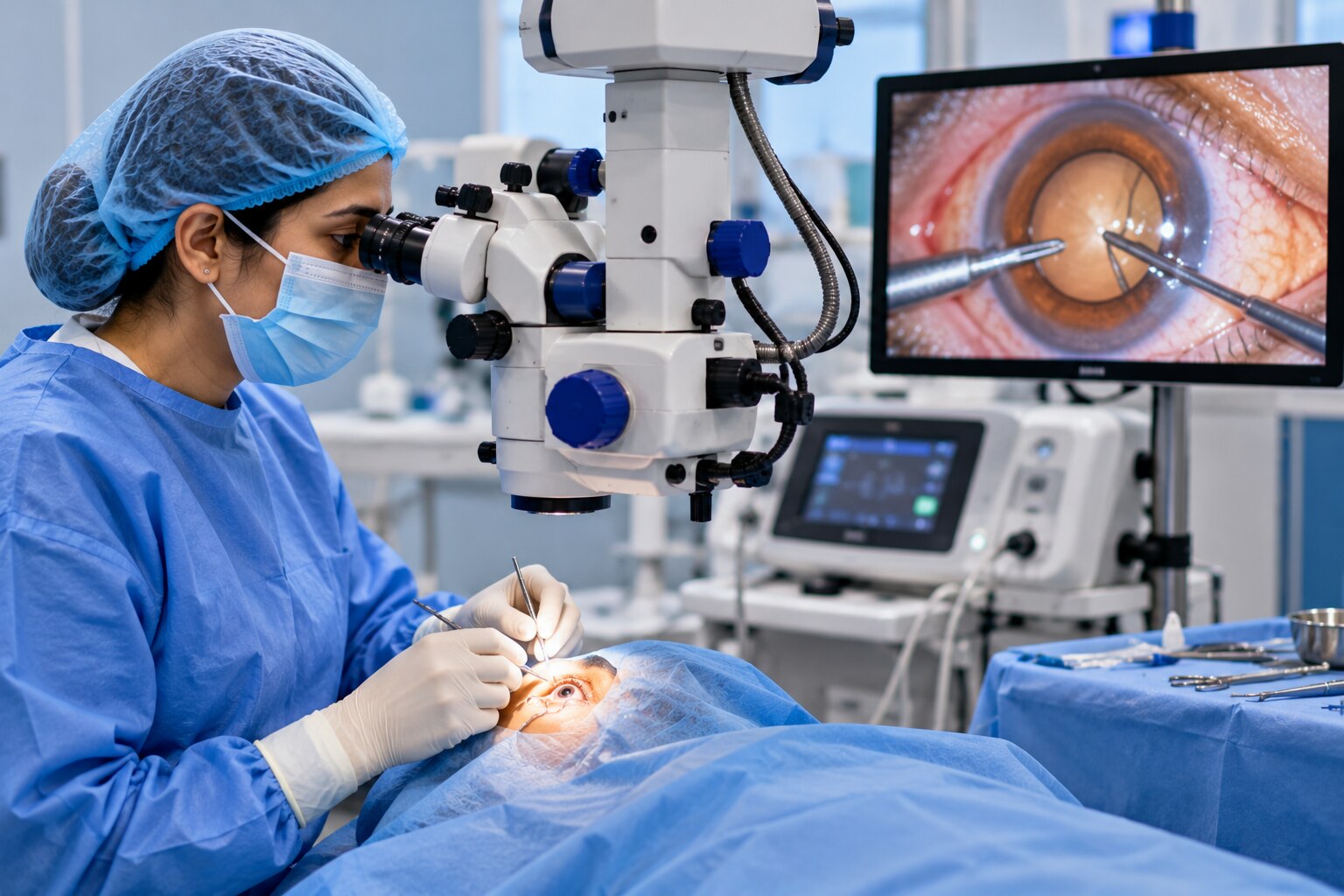
Mild blur and fluctuating focus can occur while the eye settles, but vision should move toward clearer, not progressively worse. By checking the recovery timeline, recognising urgent symptoms, and understanding the tests used to find the cause, you can decide whether to monitor, contact your surgeon promptly, or seek same-day ophthalmic care.
Key takeaways
- Gradually improving haze during the first 24 hours is usually reassuring.
- Contact your surgeon promptly if vision becomes newly blurred or worsens.
- Do not stop prescribed eye drops without speaking to your ophthalmologist.
- Take your medication list and symptom timeline to the postoperative review.
Is Blurred Vision Normal After Cataract Surgery, or an Emergency?
Blurred vision after cataract surgery is judged by its direction: gradual improvement is reassuring; new or worsening blur is not. During the first 24 hours, hazy or fluctuating vision can result from corneal swelling, inflammation, dilating drops, a disturbed tear film, or the eye’s temporary response to surgery.
- During the first week, vision should gradually become clearer. Glare, mild irritation, and changing focus can still occur.
- By the first month, the eye is often closer to its stable result. The final glasses prescription is commonly checked around 4–6 weeks, depending on the examination and whether one or both eyes were operated on.
- Contact the operating ophthalmologist promptly if blur persists, stops improving, or worsens after an initial improvement. Do not wait for the scheduled appointment.
Seek same-day urgent ophthalmic assessment for severe eye pain, marked redness, sudden vision loss, strong light sensitivity, pus-like discharge, rapidly increasing eyelid swelling, nausea with eye pain, new flashes, a sudden shower of floaters, or a curtain-like shadow. Retinal detachment can cause flashes and a curtain without pain.
Infection can cause pain, redness, discharge, swelling, light sensitivity, and rapidly worsening sight.
If you have blurry vision after cataract surgery in Mumbai, location should not delay assessment. These warning signs need same-day care whether the operation took place in Mumbai or elsewhere.
What Can Cause Persistent or Worsening Blur?
A prescription check alone cannot explain persistent cataract recovery vision problems. Corneal oedema can make the view hazy early, while inflammation inside the eye, raised intraocular pressure, dry eye, or an unstable tear film can cause fluctuating focus, burning, grittiness, or intermittent clarity.
| Cause | Typical pattern | What needs checking |
|---|---|---|
| Corneal oedema or inflammation | Early haze, irritation, light sensitivity | Slit-lamp examination |
| Dry eye or unstable tear film | Burning, grittiness, focus that clears and blurs | Ocular-surface assessment and drop review |
| Residual prescription or astigmatism | Blur after the eye settles | Refraction and the intended refractive target |
| Cystoid macular oedema | Reduced or distorted central vision several weeks later | Dilated retinal examination and OCT |
| Macular or diabetic retinal disease | Limited improvement despite a clear cornea | Retina examination and OCT |
| Raised pressure or displaced intraocular lens | Blur, pain, glare, or distorted focus | Pressure measurement and lens-position check |
Infection, including acute postoperative endophthalmitis, is more concerning when blur comes with increasing pain, marked redness, discharge, strong light sensitivity, or swelling. New flashes, a sudden shower of floaters, or a curtain-like shadow can signal a retinal tear or detachment and require emergency care.
Searching for cataract surgery complications in Mumbai does not make these symptoms safe to wait out.
Gradual haze or glare months or years after successful surgery can be posterior capsule opacification. It is sometimes called a secondary cataract, but it is not a new cataract; a YAG laser capsulotomy usually clears the cloudy capsule without replacing the intraocular lens.
How Will an Ophthalmologist Find the Source of the Blur?
Cover one eye at a time to identify the source of blurred vision after cataract surgery. Compare the operated eye, the unoperated eye, and both eyes together.
| View | What it suggests | What to do |
|---|---|---|
| Operated eye covered | Vision becomes clear | The operated eye needs review |
| Unoperated eye covered | Blur remains in the operated eye | Report the finding promptly |
| Both eyes open | Blur or double vision appears only together | Ask about eye balance, glasses, or the ocular surface |
If both single-eye views are unclear, the cause may involve both eyes, your glasses, or the tear film. Intermittent clarity with burning or grittiness points toward dry eye, but only an examination can confirm it.
Your ophthalmologist will usually:
- Measure visual acuity, then perform refraction to check a residual prescription or astigmatism.
- Use a slit lamp to examine corneal swelling, inflammation, infection, wound changes, and the position of the intraocular lens.
- Measure intraocular pressure to investigate pressure-related blur or pain.
- Dilate the pupil and examine the retina and optic nerve for tears, detachment, macular disease, bleeding, or diabetic changes.
- Perform optical coherence tomography when cystoid macular oedema or another retinal cause is suspected; OCT shows cross-sectional images of the macula.
- Add corneal assessment when swelling, surface disease, or an irregular cornea could explain the cataract recovery vision problems.
Bring your operation details, medication list, and the dates and doses of every postoperative drop.
What Should You Do Before Your Postoperative Review?
Use every prescribed postoperative drop at the stated dose and schedule while you arrange assessment. Do not stop, restart, add, or substitute steroid or antibiotic drops without medical advice; abrupt changes can be unsafe, while self-treatment can mask findings or cause harm.
| Change in vision | What to do | Timing |
|---|---|---|
| Gradually improving blur | Continue prescribed care and attend review | Keep the scheduled appointment |
| Unchanged blur | Contact the operating surgeon | Promptly |
| Worsening blur or blur returning after improvement | Contact the surgeon and request assessment | Do not wait for a routine visit |
| Sudden sight reduction or warning symptoms | Seek same-day ophthalmic care | Immediately |
Do not rub, press, or squeeze the eye. Protect it from dust and water as instructed, and wear the eye shield or other protection when advised. Attend every follow-up even if vision improves: pressure, inflammation, retinal changes, and the macula cannot be assessed reliably at home.
Seek same-day care for severe pain, increasing redness, discharge, marked light sensitivity, flashes, a sudden shower of floaters, a curtain-like shadow, nausea with eye pain, or rapidly increasing swelling. Do not drive yourself if vision suddenly falls.
Keep notes on when the blur began, whether it fluctuates, which eye is affected, and any pain, redness, discharge, flashes, or floaters. Bring your drop bottles, medication list, and operative details. The same urgency applies when searching for blurry vision after cataract surgery in Mumbai or cataract surgery complications in Mumbai.
Where Should You Seek Help for Blurry Vision After Surgery in Mumbai?
For blurry vision after cataract surgery in Mumbai, choose care by how the eye is changing, not by where the operation took place.
Contact the operating ophthalmologist or an ophthalmic emergency service immediately for severe pain, marked redness, sudden sight reduction, strong light sensitivity, pus-like discharge, rapidly increasing swelling, nausea with eye pain, new flashes, a shower of floaters, or a curtain-like shadow.
| Situation | Best next step | Why it matters |
|---|---|---|
| Red-flag symptoms or rapidly worsening sight | Same-day ophthalmic emergency assessment | Infection, retinal tear or detachment, or raised pressure needs urgent examination |
| Blur that is gradually improving | Follow the planned review schedule | Early corneal swelling, inflammation, or tear-film disturbance can settle |
| Persistent, stable, or worsening blur without emergency symptoms | Arrange a prompt postoperative review | Waiting weeks can delay treatment for macular, corneal, lens, or pressure problems |
The urgency is the same in Lower Parel, another Mumbai neighbourhood, or outside the city. An in-person examination distinguishes routine healing from infection, raised pressure, corneal swelling, macular disease, lens displacement, or retinal trouble. A refraction alone cannot do that.
Ask whether the review includes visual-acuity testing, refraction, slit-lamp examination, pressure measurement, and a dilated retinal examination. Ask about OCT if central vision is reduced or distorted, and corneal assessment if the surface seems responsible.
Clarity Eye Clinic-Dr.Nikita Mashru in Lower Parel can provide ophthalmic assessment when cataract surgery complications in Mumbai require corneal, retinal, pressure, or lens evaluation.
Take your discharge papers, operative report, medication bottles, and previous vision measurements.
Related service
PREMIUM CATARACT SURGERY by Dr. Nikita Mashru Premium Cataract Surgery at Clarity Eye Clinic, Lodha Signet, Lower Parel, Mumbai, offers advanced cataract treatment with a... View service → |
Frequently asked questions
Is blurred vision normal after cataract surgery?
Hazy or fluctuating vision during the first 24 hours can follow corneal swelling, inflammation, dilating drops, a disturbed tear film, or the eye’s temporary response to surgery. Gradual improvement is reassuring; new or worsening blur needs prompt medical advice.
What can cause persistent or worsening blur after cataract surgery?
Possible causes include ongoing corneal swelling, inflammation, tear-film disturbance, medication-related effects, or another postoperative complication. An ophthalmologist must examine the eye to identify the cause.
How will an ophthalmologist investigate blurry vision after cataract surgery?
The ophthalmologist reviews when the blur began and whether it is improving, checks the eye and cornea, assesses inflammation and the tear film, and evaluates the eye for postoperative complications.
What should I do before my postoperative review?
Use prescribed drops exactly as directed, note when the blur started and whether it is worsening, avoid changing treatment on your own, and take your medication list and surgery details to the appointment.
Keywords