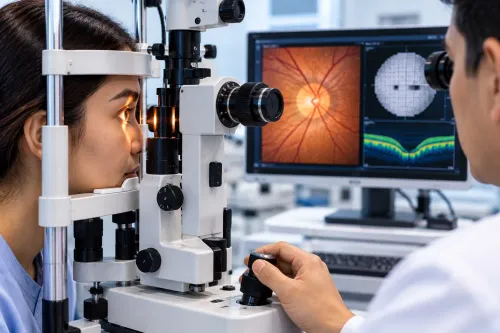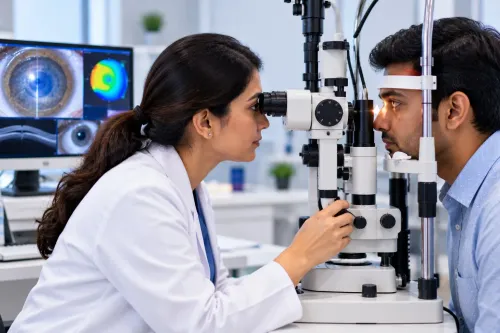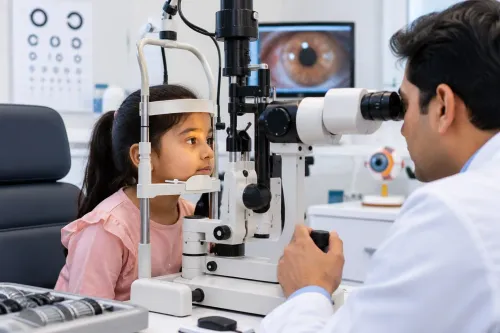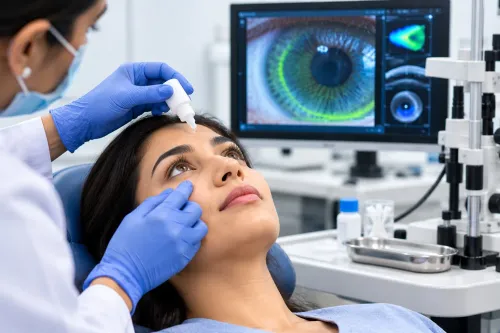
LASIK and SMILE are not interchangeable choices, and the faster advertised recovery does not determine which procedure is safe for your eyes. By comparing the techniques, testing requirements, recovery demands, and long-term trade-offs, you can identify the questions to take to a refractive surgeon in Mumbai and recognise when glasses, contact lenses, or another procedure is the better option.
Key takeaways
- LASIK uses a corneal flap; SMILE removes a lenticule through a small incision.
- Your prescription, corneal thickness, dryness, and eye health determine suitability.
- Ask about recovery restrictions, complication risks, enhancements, and alternative treatments.
- Choose after a complete corneal mapping and refractive surgery consultation.
LASIK and SMILE: how the procedures differ
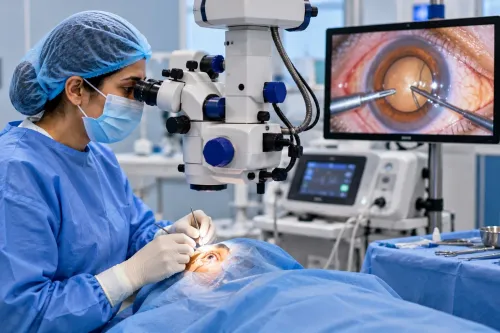
The practical difference is how each procedure reaches the cornea. LASIK creates a hinged flap, reshapes the underlying corneal tissue with an excimer laser, and replaces the flap. SMILE uses a femtosecond laser to form and remove a lens-shaped piece of tissue, called a lenticule, through a small incision without making a LASIK-style flap.
| Feature | LASIK | SMILE |
|---|---|---|
| Access | Hinged corneal flap | Small corneal incision |
| Tissue removal | Surface is reshaped beneath the flap | Internal lenticule is removed |
| Early vision | Often becomes clear quickly | Clear vision can take longer to settle |
| Surface symptoms | Flap and surface disruption can aggravate dryness | Smaller incision can reduce surface disruption, but dryness remains possible |
| Trauma concern | A significant blow can displace the flap, even later | No LASIK-style flap, but the cornea still needs protection |
| Enhancement | Flap lifting or another technique may be considered | Surface ablation or another technique may be needed |
Neither procedure is automatically better. The correct choice depends on your prescription, corneal thickness and shape, tear-film health, and visual demands; the treatment range is not interchangeable between laser platforms. Someone concerned about contact-sport trauma may prefer discussing SMILE eye surgery in Mumbai, while another patient may gain faster initial clarity from LASIK.
Ask how much corneal tissue remains and what enhancement plan applies if power returns. Continue spectacles or consider PRK or a phakic intraocular lens when corneal findings make both unsuitable.
Which prescriptions and eye conditions favour each procedure?
A prescription alone cannot decide suitability. For “lasik or smile which is better for me in mumbai,” the surgeon must match your refractive error to the exact laser platform, corneal thickness and shape, tear-film health, and expected tissue removal.
A stable spectacle prescription for at least one year and age 18 or older are common starting points.
| Option | Factors that may favour it | Important limits |
|---|---|---|
| LASIK | Broad treatment flexibility; useful when rapid visual recovery matters or precise treatment of astigmatism is planned | A flap matters for contact sports, eye-trauma risk, thin or irregular corneas, and pre-existing dry eye |
| SMILE | No LASIK-style flap; attractive for people exposed to eye trauma or with dry-eye concerns | Not suitable for every prescription, corneal shape, or platform; it still carries corneal-surgery risks |
| Neither | Keratoconus, suspicious tomography, inadequate thickness, uncontrolled dry eye, unstable power, or unrealistic expectations | Consider spectacles, contact lenses, PRK, or a phakic intraocular lens instead |
Dry eye, blepharitis, allergy, contact-lens intolerance, glare, and fluctuating vision need treatment or reassessment before either procedure. SMILE may disturb fewer corneal nerves, but it does not eliminate postoperative dryness or visual symptoms.
Your job and sport change the trade-off: a boxer, police officer, or football player may value avoiding a flap, while someone needing rapid recovery for screen-based work may prioritise the procedure that fits their timeline.
“Lasik vs smile in mumbai” should therefore end with a suitability decision, not a choice based only on price, advertising, or recovery promises.
What happens during a refractive surgery consultation in Mumbai?
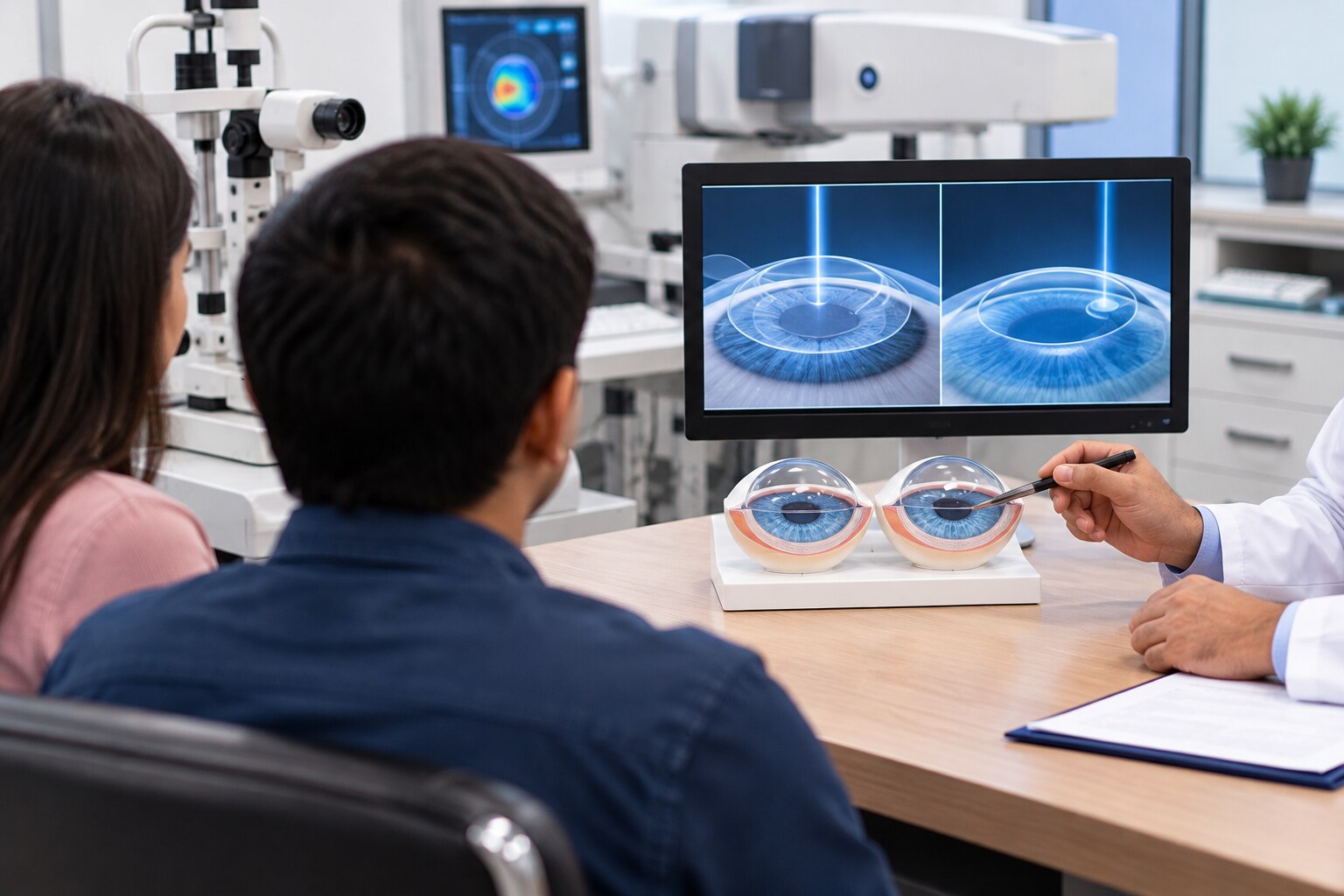
A proper refractive surgery consultation in Mumbai begins with your history, not a choice between two advertised procedures. The surgeon checks prescription stability, contact-lens use, previous eye disease or surgery, dry-eye symptoms, age, occupation, sports exposure, and expectations. A LASIK suitability assessment in Mumbai should include these examinations:
| Examination | What it checks | Why it matters |
|---|---|---|
| Manifest refraction, with cycloplegic refraction when indicated | Exact spectacle power | Confirms the correction and detects hidden focusing effort |
| Corneal topography or tomography | Corneal shape, thickness distribution, and early keratoconus signs | An abnormal map can rule out corneal laser surgery |
| Pachymetry | Thinnest corneal thickness | Shows whether enough tissue remains after treatment |
| Slit-lamp examination | Cornea, lens, eyelids, and ocular surface | Finds scars, inflammation, infection, or other disease |
| Tear-film and dry-eye testing | Tear quantity and stability | Untreated dryness can worsen discomfort and fluctuating vision |
| Intraocular-pressure measurement and retinal examination | Pressure, optic nerve, and retina | Detects problems unrelated to refractive error |
The surgeon then verifies that your power is stable and that the specific laser platform covers your prescription safely. Clarity Eye Clinic-Dr.Nikita Mashru can use these findings to discuss LASIK, SMILE, PRK, phakic intraocular lenses, or continuing with spectacles.
No surgery is the safer answer when corneal maps, tear-film results, retinal findings, or expectations are unfavorable. Ask how a future enhancement would be handled; adequate remaining tissue and a stable error are essential.
Related service
LASIK / SMILE EYE SURGERY by Dr. Nikita Mashru LASIK and SMILE at Clarity Eye Clinic, Lodha Signet, Lower Parel, Mumbai, offer modern options for reducing dependence on... View service → |
Recovery, restrictions, and complications after LASIK or SMILE
LASIK usually provides functional vision within about a day; SMILE vision often sharpens more gradually over several days or longer. Neither timeline is guaranteed, and dry eye, prescription strength, corneal response, and residual refractive error affect recovery.
| Procedure | Early recovery | Daily-life difference |
|---|---|---|
| LASIK | Faster visual clarity; gritty sensation, watering, light sensitivity, and fluctuating vision can occur | Avoid rubbing or pressing the eye; the flap remains vulnerable to significant trauma, including late after surgery |
| SMILE | Vision may clear more slowly; discomfort is usually limited but blurred or fluctuating vision can persist | No flap exists, but the small incision still needs protection and contact-sport restrictions |
Use prescribed drops exactly as directed, attend follow-up visits, and do not drive until vision is clear and your surgeon permits it. Keep water, dust, eye makeup, swimming, and vigorous exercise away from the eyes for the period specified by your surgeon; rubbing can worsen healing after either procedure.
Both operations can cause dry-eye symptoms, glare, halos, starbursts, reduced contrast, under-correction, over-correction, infection, or corneal weakening. LASIK generally affects more corneal nerves, while SMILE may reduce but does not eliminate dry eye. Seek urgent review for severe pain, sudden vision loss, marked redness, or rapidly worsening vision.
An enhancement is not automatic. A stable, explainable residual error and adequate remaining corneal tissue are necessary; SMILE enhancement may require surface ablation or another technique, while LASIK flap lifting or recutting carries its own risks.
How to make the final decision, including enhancements and alternatives
Choose the option that your measurements support safely, not the procedure with the fastest advertised recovery or lowest price. Review the prescription range of the exact laser platform, corneal thickness and shape, tear-film status, age, visual needs, and expected result with the surgeon.
| Option | What it means | When it applies |
|---|---|---|
| LASIK | Creates a corneal flap before laser reshaping | Suitable when the cornea, tear film, and prescription meet safety limits |
| SMILE | Removes a lenticule through a small incision | Useful when the approved platform covers your prescription and avoiding a flap matters |
| PRK or surface ablation | Reshapes the surface without creating a flap | Considered when flap-related concerns or corneal measurements favour surface treatment |
| Phakic intraocular lens | Places a lens inside the eye without removing corneal tissue | Selected prescriptions or corneas unsuitable for laser correction |
| Spectacles or contact lenses | No surgical tissue change | Safest choice when tomography, ocular surface, prescription stability, or expectations are unfavourable |
Ask how a residual or returning error would be managed before consenting. Enhancement is not automatic: the error must be stable and explainable, with adequate remaining corneal tissue. After LASIK, lifting or recutting the flap has risks; after SMILE, enhancement may require PRK or another flap-based procedure.
A Mumbai consultation should leave you comfortable choosing no surgery when the risk-benefit balance is poor.
Frequently asked questions
How do LASIK and SMILE differ?
LASIK creates a hinged corneal flap and reshapes tissue with an excimer laser. SMILE removes a laser-created lenticule through a small incision without creating a LASIK-style flap.
Which prescriptions and eye conditions favour LASIK or SMILE?
Suitability depends on your prescription, corneal thickness and shape, tear-film health, eye history, and the amount of tissue required for correction. A detailed suitability assessment determines which procedure fits your eyes.
What happens during a refractive surgery consultation in Mumbai?
The consultation includes a medical and eye history, refraction testing, corneal mapping and thickness measurements, tear-film assessment, pupil evaluation, and a discussion of procedure-specific risks and alternatives.
How long is recovery after LASIK or SMILE?
Recovery timelines differ between individuals and procedures. Your surgeon will provide instructions for eye drops, bathing, screen use, driving, exercise, swimming, contact sports, and follow-up visits.
What complications can occur after LASIK or SMILE?
Possible issues include dry eye symptoms, glare, halos, fluctuating vision, undercorrection, overcorrection, infection, inflammation, and the need for further treatment. Your surgeon should explain your individual risk before surgery.
Keywords