Choosing a premium cataract procedure involves more than selecting the most advanced-sounding lens. You will be able to compare lens designs, understand the measurements that affect accuracy, assess your suitability, and prepare practical questions for a local surgeon and clinic.
Key takeaways
- Premium IOLs include toric, enhanced-monofocal, multifocal, trifocal, and EDOF lenses.
- Choose an IOL after reviewing your eye health, visual priorities, and tolerance for visual side effects.
- Preoperative biometry, corneal measurements, retinal checks, and tear-film assessment guide lens selection.
- Compare the surgeon’s experience, testing process, lens options, follow-up plan, and total treatment costs.
What premium cataract surgery adds beyond a standard monofocal procedure
Premium cataract surgery adds lens-specific planning to cataract removal; it is not a standardised procedure or accreditation category. The term usually describes a toric, enhanced-monofocal, multifocal, trifocal, or extended-depth-of-focus intraocular lens (IOL), supported by extra measurements and refractive calculations beyond a standard monofocal plan.
- Decide whether cataract surgery is needed from functional impairment and quality of life: difficulty reading, driving, working, or recognising faces matters more than waiting for a “mature” cataract or reaching a particular visual-acuity score.
- Match the IOL to your priorities. A standard monofocal lens gives one main focus, while premium options aim to improve astigmatism correction or provide useful intermediate and near vision.
- Check the conditions that can limit the result. Residual prescription, ocular-surface disease, retinal disease, glaucoma, corneal irregularity, and neural adaptation all affect visual quality; unstable dry eye can also make calculations inaccurate.
- Set the right outcome. Premium planning aims to reduce dependence on glasses, not guarantee spectacle-free vision. Halos, glare, reduced contrast, and low-light difficulty remain important trade-offs with multifocal and trifocal designs.
People searching for premium cataract surgery for Mumbai in Lower Parel should ask which exact IOL model is proposed, what visual range it targets, and how residual refractive error will be managed. The label alone tells you little; the measurements, eye health, and agreed visual goal determine whether the upgrade suits you.
Which intraocular lens matches your vision priorities and eye condition
Your priority may be distance, computer work, reading, or fewer glasses; the right intraocular lens also depends on whether your cornea, retina, optic nerve, and tear film can support that goal. A toric lens needs accurate measurements and stable alignment, because rotation reduces astigmatism correction.
| Lens type | Main vision target | Reading glasses and compromises |
|---|---|---|
| Monofocal | One focus, usually distance | Reading glasses remain necessary; fewer halos and stronger contrast |
| Enhanced-monofocal | Distance with a broader useful intermediate range | Near glasses remain likely; usually fewer night-vision effects than multifocal designs |
| Toric | Distance or another chosen focus while correcting regular astigmatism | Benefit falls if calculations are wrong or the lens rotates; reading glasses may still be needed |
| Multifocal or trifocal | Distance, intermediate, and near focal points | Greater spectacle independence, but halos, glare, reduced contrast, and more difficulty with night driving or low-light vision |
| Extended-depth-of-focus | Distance extending into intermediate vision | Less near power than a trifocal; reading glasses remain more likely, with fewer optical disturbances than multifocals |
For premium cataract surgery for Mumbai in Lower Parel, ask which exact lens model and optical goal are proposed rather than relying on the word “premium.” Multifocal and trifocal lenses can be a poor fit when the macula has significant disease, including diabetic retinal disease, or when you have an irregular cornea, uncontrolled dry eye, glaucoma, amblyopia, or unrealistic expectations.
A monofocal or toric option may be safer when contrast, night driving, or predictable correction matters more than spectacle independence.
Which preoperative tests determine whether a premium lens is suitable
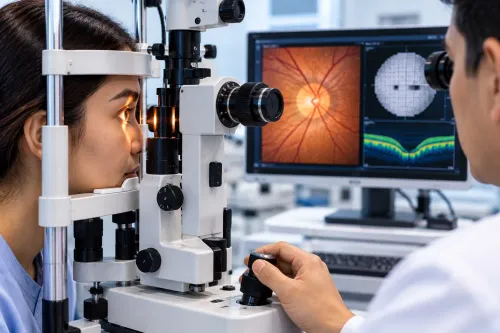
The IOL recommendation starts with measurements, not lens marketing. Optical biometry measures eye length and calculates IOL power; ultrasound biometry is used when a dense cataract blocks a reliable optical reading.
| Test | What it measures | Why it matters |
|---|---|---|
| Optical biometry | Eye length and related dimensions | Calculates IOL power |
| Ultrasound biometry | Eye length through sound waves | Helps when a dense cataract prevents optical measurement |
| Keratometry | Corneal curvature and regular astigmatism | Supports toric-lens power and alignment planning |
| Corneal topography | The cornea’s surface shape | Identifies irregularity that can undermine premium-lens results |
| Ocular-surface assessment | Tear-film stability and dry eye | An unstable surface can distort toric, multifocal, and extended-depth-of-focus calculations |
| Macular evaluation | Retinal conditions affecting the macula | Disease can reduce contrast and usable vision, making a multifocal or trifocal lens a poor fit |
| Optic-nerve examination and glaucoma testing | Nerve health and eye pressure risk | Added when symptoms, medical history, or examination findings suggest glaucoma |
Before choosing a cataract surgeon near Parel, ask:
- Who performs each measurement, and what equipment is used?
- Does the surgeon personally review the biometry before recommending the IOL?
- If dry-eye treatment changes the readings, will the corneal measurements be repeated?
- What happens if the final prescription differs from the target, or a toric lens rotates?
A technically successful operation cannot remove the effects of retinal disease, glaucoma, corneal irregularity, or an unstable ocular surface. Measurements must describe the eye accurately first.
What happens from consultation through recovery and follow-up
At consultation, you discuss reading, screen use, driving, work, night vision, and your expectation of spectacle independence. The surgeon reviews your medical history and medicines, completes the measurements, and uses the findings to recommend an IOL.
| Stage | What happens | What you receive |
|---|---|---|
| Consultation | Activities, eye health, medicines, measurements, and IOL choices are reviewed | A personalised surgical plan |
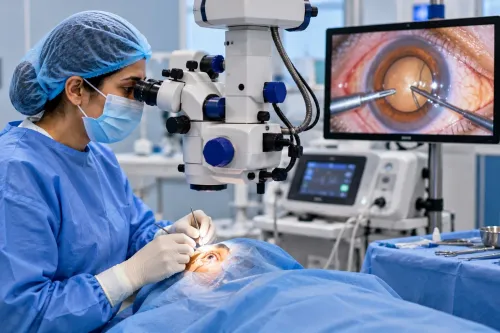
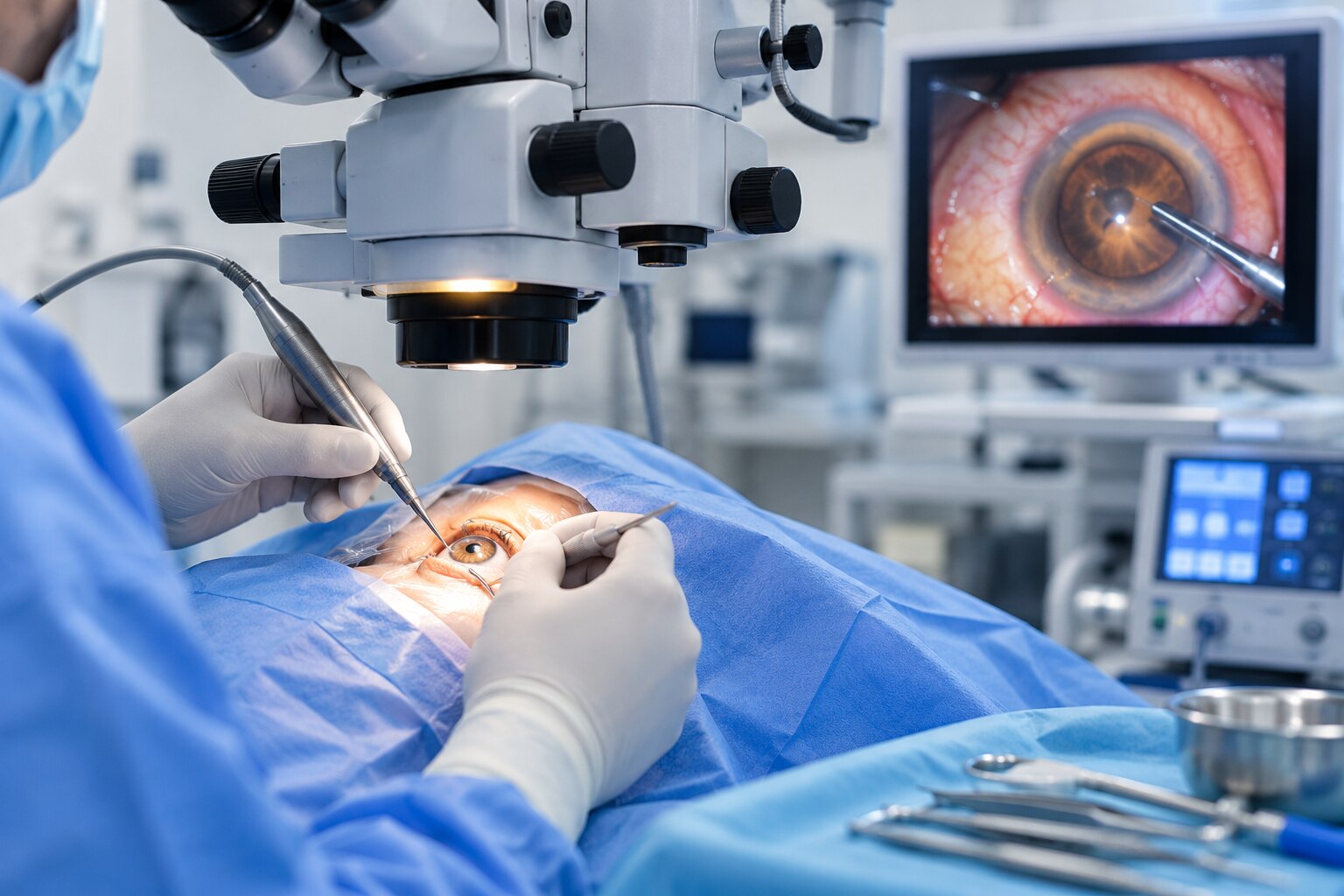
| Surgery day | Topical or local anaesthesia is given; the cataract is removed and the IOL implanted as an outpatient procedure | A dressing or shield, prescribed drops, and written restrictions |
| Early review | Vision, eye pressure, inflammation, corneal clarity, and IOL position are checked | Updated drops and activity guidance |
| Later review | Healing and the remaining prescription are assessed | Advice about glasses or further treatment |
Blur, light sensitivity, glare, and halos can occur early. Screen use, bathing, driving, exercise, and returning to work depend on visual clarity, healing, which eye was operated on, and the surgeon’s restrictions—not a fixed timetable.
A short operation still needs reviews because infection inside the eye, inflammation, raised pressure, retinal detachment, cystoid macular oedema, corneal swelling, IOL problems, and refractive surprise can threaten the result. Months or years later, posterior capsule opacification can cloud vision; YAG laser capsulotomy usually treats it.
Seek urgent ophthalmic assessment for:
- Severe pain or rapidly worsening vision
- Marked redness
- Increasing floaters or flashes
- A curtain-like shadow
If you are searching for premium cataract surgery for Mumbai in Lower Parel, choose a facility that can provide early reviews and rapid urgent assessment.
How to compare a cataract surgery clinic and surgeon near Lower Parel
A sound comparison asks about the proposed lens, not just the clinic’s total cataract volume. If you are choosing a cataract surgery clinic in Lower Parel or a cataract surgeon near Parel, request specific answers before booking.
| Question | What a useful answer includes | Warning sign |
|---|---|---|
| Exact IOL | Brand, model, and optical design: toric, enhanced-monofocal, multifocal, trifocal, or EDOF | “Premium lens” without a model or optical goal |
| Lens experience | Number of eyes the surgeon has treated with that lens category | Only general cataract numbers are provided |
| Measurements | Who performs biometry, keratometry, topography, and surface checks; whether the surgeon reviews results | Measurements are technician-only with no surgeon review |
| Aftercare | Plan for residual prescription, toric-lens rotation, and posterior capsule opacification | No named plan for YAG capsulotomy or refractive correction |
| Urgent support | Local assessment for severe pain, rapidly worsening vision, marked redness, flashes, floaters, or a curtain-like shadow | You are told to wait for the next routine visit |
Ask how many glasses-free hours the lens is intended to provide, and what halos, glare, reduced contrast, or night-driving limits you should expect. Spectacle dependence is reduced, not guaranteed.
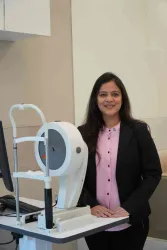
Proximity matters because early reviews and rapid assessment are easier. It should not outweigh lens-specific experience, diagnostic capability, and honest counselling. Clarity Eye Clinic-Dr.Nikita Mashru can be compared with other local options by confirming who handles consultation, surgery, follow-up, YAG treatment, and urgent contact.
Related service
PREMIUM CATARACT SURGERY by Dr. Nikita Mashru Premium Cataract Surgery at Clarity Eye Clinic, Lodha Signet, Lower Parel, Mumbai, offers advanced cataract treatment with a... View service → |
Frequently asked questions
What does premium cataract surgery add beyond a standard monofocal procedure?
It adds lens-specific planning and may use toric, enhanced-monofocal, multifocal, trifocal, or extended-depth-of-focus IOLs, supported by additional measurements and refractive calculations.
How do you choose the right premium intraocular lens?
Match the IOL to your priorities for distance, intermediate, and near vision, while considering astigmatism, corneal health, retinal disease, glaucoma, dry eye, and tolerance for glare or halos.
Which tests determine whether a premium IOL is suitable?
Assessment can include optical biometry, corneal topography or tomography, keratometry, ocular surface evaluation, dilated retinal examination, macular OCT, and a review of existing eye conditions.
What happens from cataract consultation through recovery?
The process includes examination and measurements, IOL planning, surgery with postoperative medicines, an early review, and follow-up checks for vision, eye pressure, inflammation, and healing.
How should you compare a cataract surgery clinic near Lower Parel?
Compare the surgeon’s qualifications and experience, diagnostic equipment, IOL choices, complication management, itemised fees, operating facility, and follow-up arrangements.
Keywords