
Persistent redness, pain, light sensitivity, blurred vision, recurrent erosions, halos, watering, discharge, or a visible corneal spot can require more than an optical-shop check or a new glasses prescription. By the end, you will know when to seek same-day care, which corneal qualifications and tests to confirm, and what to ask before booking an appointment near Lower Parel.
Key takeaways
- Seek urgent eye assessment for sudden pain, light sensitivity, or blurred vision.
- Book a cornea-trained ophthalmologist rather than relying on a glasses check.
- Expect slit-lamp examination, corneal mapping, and eye-pressure testing when indicated.
- Confirm diagnostic equipment, surgical expertise, fees, and follow-up before booking.
When corneal symptoms need an appointment or urgent assessment
Book a planned ophthalmic assessment for persistent redness, eye pain, light sensitivity, blurred vision, recurrent corneal erosions, halos, watering, discharge, or a visible spot on the cornea. These symptoms can reflect ocular-surface disease, keratitis, scarring, dystrophy, pterygium, or keratoconus; a glasses check alone cannot assess corneal health.
| Situation | Action | Why it matters |
|---|---|---|
| Persistent or recurring symptoms without sudden deterioration | Book a cornea appointment | The cause needs examination, even when symptoms come and go |
| Sudden vision loss, a painful red eye, chemical splash, penetrating injury, or suspected contact-lens-related infection | Seek same-day emergency eye care | Infection, trauma, or chemical injury can threaten sight quickly |
Rinse a chemical splash immediately with clean running water while seeking urgent help. Do not rub an injured eye, press on it, or try to remove an embedded object. Never wear contact lenses when you have pain, redness, light sensitivity, or reduced vision; remove them and seek prompt care.
If you are comparing cornea care in lower parel, choose an ophthalmologist with cornea and external-eye expertise rather than relying on an optical shop, optometrist, or unrelated retina or glaucoma consultation. Ask about the clinician’s experience with your suspected condition, including keratoconus, corneal ulcer, infectious keratitis, or recurrent erosion.
A painful red eye with discharge or a white corneal spot is not a routine booking.
Which eye professional should you book for a corneal problem?
Book an ophthalmologist with specific cornea and external-eye training if you have keratoconus, a corneal ulcer, infectious keratitis, corneal scarring, corneal dystrophy, recurrent corneal erosion, pterygium, severe ocular-surface disease, or need transplant follow-up. Search for a cornea specialist in Lower Parel, then confirm that the clinician routinely manages your particular condition.
| Provider | Main focus | Why it may or may not fit |
|---|---|---|
| Cornea specialist | Cornea, external eye, ocular surface, and corneal surgery | Appropriate for the conditions above |
| General ophthalmologist | Broad medical and surgical eye care | Suitable for initial assessment, with cornea referral when needed |
| Optometrist | Vision testing, refraction, and glasses or contact-lens fitting | Cannot replace medical assessment of corneal disease |
| Retina specialist | Retina and vitreous disorders | Not the right subspecialist for an isolated corneal problem |
| Glaucoma specialist | Eye-pressure and optic-nerve disease | Not the right subspecialist for corneal shape, infection, or scarring |
| Dry-eye-only consultation | Tear-film and surface symptoms | Insufficient when infection, structural disease, or corneal damage is suspected |
Ask the clinic:
- Does the ophthalmologist routinely treat my suspected condition?
- For possible keratoconus, will both eyes be assessed and monitored?
- Will progression be tracked using corneal shape, thickness, and visual function rather than one refraction?
Persistent burning or fluctuating vision deserves tear-film and ocular-surface evaluation, including staining and eyelid or meibomian-gland assessment—not just repeated lubricating drops.
What the first cornea appointment and tests can reveal
A proper first cornea appointment begins with your symptoms and contact-lens history: onset, pain, redness, light sensitivity, discharge, injuries, previous infections, lens type, wearing schedule, cleaning routine, and sleeping in lenses. Remove lenses before examination, and bring the lens case and solution.
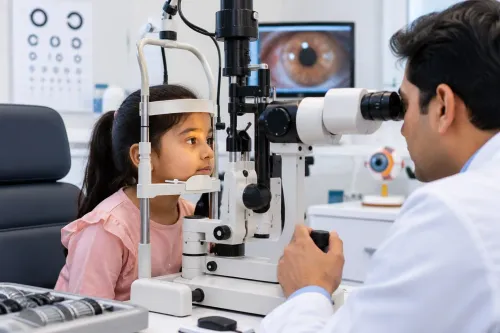
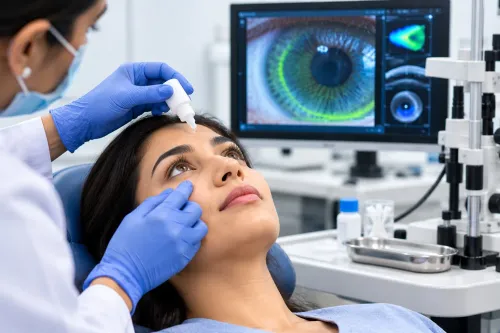
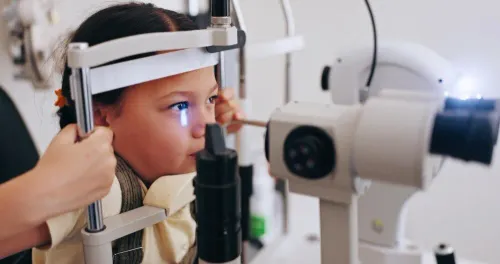
You will have visual-acuity testing, eye-pressure measurement, and a slit-lamp examination of the cornea, conjunctiva, eyelids, and tear film. Fluorescein corneal staining can expose abrasions, erosions, or surface damage; tear-film assessment checks stability, dryness, and ocular-surface disease. The clinician dilates your pupils when a wider internal-eye examination is needed.
A glasses prescription alone cannot establish corneal health. Ask whether a cornea clinic near Parel can arrange these tests when clinically indicated.
| Test | What it reveals | Why it matters |
|---|---|---|
| Corneal topography or tomography | Surface shape and irregular curvature | Detects and monitors keratoconus |
| Pachymetry | Corneal thickness | Supports risk assessment and procedure planning |
| Anterior-segment optical coherence tomography | Detailed images of front-of-eye structures | Clarifies scars, thickness, and tissue layers |
| Corneal photography | A documented visual baseline | Allows comparison at follow-up visits |
| Microbial sampling | The organism causing suspected infection | Guides targeted treatment |
A basic vision check may stop after refraction, but a cornea assessment connects symptoms with tissue findings. For suspected infection, tell the clinician immediately about worsening pain, light sensitivity, reduced vision, or discharge rather than waiting for routine testing.
Which treatments might follow the examination?
Treatment follows the examination finding, and many corneal problems need no surgery. Care may involve lubricating drops, antibiotic or antiviral medicine, removal of a foreign body, a contact-lens change, or treatment of an underlying ocular-surface cause such as blepharitis or tear-film disease.
Never start steroid eye drops without an ophthalmologist’s direction. Steroids can worsen certain infections, including herpes simplex keratitis, and delay the treatment that protects vision.
A practical comparison for cornea treatment in Mumbai is:
| Route | What it does | When it applies |
|---|---|---|
| Medical care | Treats infection, irritation, dryness, or surface inflammation | Bacterial or viral disease, dry eye, or a foreign body |
| Contact-lens adjustment | Changes wear, fit, material, or replacement schedule | Lens-related irritation, injury, or infection risk |
| Corneal cross-linking | Strengthens corneal tissue to slow or stop keratoconus progression | Documented or progressive keratoconus |
| Phototherapeutic keratectomy | Removes selected superficial corneal tissue with a laser | Certain surface scars, dystrophies, or irregularities |
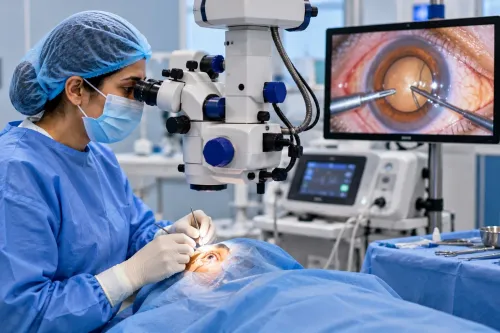
| Corneal transplantation | Replaces diseased corneal tissue | Dense scarring, advanced disease, or failed corneal function |
Cross-linking does not guarantee freedom from spectacles or contact lenses; optical rehabilitation often remains necessary.
Penetrating keratoplasty replaces the full corneal thickness. Lamellar procedures replace selected layers, so ask which corneal layer is affected and why that technique is proposed before agreeing to a transplant referral.
What to confirm before booking in Lower Parel
A safe booking for cornea care in Lower Parel starts with the clinician and testing available, not the clinic’s distance alone. Use this checklist when comparing a cornea clinic near Parel:
1. Ask whether an ophthalmologist with cornea and external-eye expertise will assess you, and whether the service routinely manages your suspected problem, such as keratoconus, ulcer, keratitis, scarring, dystrophy, recurrent erosion, pterygium, severe ocular-surface disease, or transplant follow-up.
2. Confirm that slit-lamp examination, corneal topography or tomography, pachymetry, ocular-surface assessment, and infection sampling can be arranged when indicated. A glasses prescription cannot establish corneal health.
3. Check the earliest appointment, expected visit duration, records to bring, and contact-lens instructions. Ask whether both eyes will be assessed for suspected keratoconus and how progression will be monitored.
4. Ask what to do if pain, redness, light sensitivity, discharge, or vision worsens before the appointment. Do not wait for a routine slot after sudden vision loss, a painful red eye, chemical splash, penetrating injury, or suspected microbial keratitis. Remove contact lenses; rinse a chemical splash with clean running water and seek urgent care.
For anyone considering Clarity Eye Clinic-Dr.Nikita Mashru at Lodha Signet, Lower Parel, directly confirm current booking availability, timing, access, and urgent-care arrangements rather than assuming unpublished details.
Bring prior scans, prescriptions, medication lists, contact-lens details, and transplant or surgical records.
Related service
CORNEA CARE by Dr. Nikita Mashru Cornea Care at Clarity Eye Clinic, Lodha Signet, Lower Parel, Mumbai, focuses on the diagnosis, evaluation, and management of... View service → |
Frequently asked questions
When should corneal symptoms receive urgent assessment?
Seek urgent assessment for sudden or severe eye pain, marked light sensitivity, rapidly worsening blurred vision, a visible corneal spot, or symptoms after an eye injury or contact-lens use.
Which eye professional should you book for a corneal problem?
Book an ophthalmologist with cornea and external-eye expertise. A routine optometrist or glasses check cannot assess every corneal condition or provide surgical treatment.
What happens during a first cornea appointment?
The ophthalmologist reviews your symptoms and history, checks vision and eye pressure, examines the cornea with a slit lamp, and orders tests such as corneal topography or pachymetry when needed.
Which treatments might follow a cornea examination?
Treatment depends on the diagnosis and can include lubricating drops, prescription medication, contact-lens changes, removal of a surface lesion, corneal cross-linking, or corneal surgery.
What should you confirm before booking cornea care in Lower Parel?
Confirm the doctor’s cornea expertise, available diagnostic tests, treatment options, consultation fees, emergency access, and the follow-up plan before booking.
Keywords